
How to Recover Files That Disappeared From a Flash Drive


After connecting your USB drive to your computer, were you surprised to find that some of your files had disappeared? Missing files are often still recoverable, depending on what caused them to disappear. In this article, we’ll look at why this happens and how to recover files that disappeared from your USB flash drive.
Why Do Files Disappear From USB Drives?
If your USB files are not showing up, follow this order:
- Make sure your USB appears in File Explorer and Disk Management with the correct capacity, then check whether the missing files are simply hidden.
- If files were deleted or became inaccessible, stop using the USB and use data recovery software like Disk Drill to recover them to another drive.
- Once the files you need are safely stored elsewhere, you can work on the solution for the USB itself ( unhiding files, removing malware, repairing the file system, restoring a lost partition, or formatting the USB if needed).
- If it’s damaged, unstable, not detected, or shows an abnormal capacity, avoid further DIY attempts and consider professional recovery.
As with most USB issues, start by checking whether the drive itself is working and Windows can detect it correctly. File Explorer and Disk Management can tell you quite a lot before you try to recover anything.
| What you see | What it means | |
| Open the USB in File Explorer | The drive opens and you can browse its contents. | The USB is readable. If only some files are missing, continue with the checks below to find out what happened to them. |
| Open the USB in File Explorer | Windows asks you to format the drive or can’t open it. | Don’t format it. The file system may be corrupted or incompatible with Windows. If the files are important, recover them before attempting repairs. |
| Check the USB in Disk Management | The drive appears with its normal capacity. | Windows can detect the device correctly, so you can continue with data recovery and further troubleshooting. |
| Check the USB in Disk Management | The capacity is incorrect or the drive behaves inconsistently. | Stop DIY attempts. This can indicate a hardware problem, and a data recovery service is the safer option. |
| Check both File Explorer and Disk Management | The USB doesn’t appear in either place. | Try another USB port or another computer. If it still isn’t detected, software won’t be able to recover it, so professional recovery is the next option. |
If your USB passes these basic checks, the next step is to figure out what caused the files to disappear. There’s no single reason why your files may have disappeared from your USB flash drive. Before you try to recover the files missing from your flash drive, it’s important to understand why they may have disappeared so you can prevent further data loss and the table below covers the most common possibilities.
Reason | Description |
🗑️ Accidental deletion | Accidents happen. A simple misclick can result in some or all of your data becoming deleted. Even formatting can happen by mistake. In these cases, we recommend recovering your data right away. |
🦠 Virus infection | Malware, like viruses, can infect your USB flash drive and either hide or delete your files. Remove any viruses first, then show hidden files. If they’re deleted, perform data recovery. |
| 🔄 Failed/incomplete file transfer | If files disappear immediately after being copied to the USB, the transfer may not have completed successfully. This can happen if the drive is disconnected too early, the connection drops, or the copy process is interrupted. Check whether the original files are still available on the source device. If not, you may need to recover them from the source or the USB. |
⚠️ File system corruption | A broken file system prevents your operating system from finding your data. It can happen as a result of physical or logical damage, such as improper ejection. You can recover the data first, then try fixing the flash drive. |
💥 Physical damage | Physical damage is the worst kind. It can result from the USB drive being dropped, crushed, or otherwise physically damaged. If the damage is only cosmetic and the drive remains stable, is detected consistently, and shows the correct capacity, you can try data recovery yourself. Create an image of the USB first and scan the image rather than the drive itself. If the USB disconnects, isn’t detected, shows the wrong capacity, or has other signs of hardware failure, avoid further DIY attempts and contact a professional data recovery service. |
⏏️ Improper ejection | Removing a USB flash drive before ejecting it safely can interrupt active processes, corrupting the data or file system. Recover or back up your data first, then try repairing the file system. If the problem can’t be fixed, you can reformat the USB to recreate the file system. |
🖊️ Accidental overwriting | Overwritten files cannot be recovered using data recovery software. Instead, you should restore the files from a backup or restore them to a previous version using File History. |
❌ Fake USB | Scammers often sell USB drives and claim they have a higher capacity than they actually do. These USB drives are modified so they look legit when you plug them in, but when you write large amounts of data that exceed their actual capacity, the files disappear or become corrupted. You can check this using Fake Flash Test. |
Methods for Recovering Files That Have Disappeared From a Flash Drive
There are lots of methods available for recovering files that have disappeared from your USB flash drive. We recommend you start with the first method and work your way along to ensure you’re not missing any important steps.
Method 1: Use a Recovery Tool to Restore Disappeared Files
In cases where you can’t restore your data from a backup after your USB drive files disappeared, using data recovery software to perform flash drive data recovery is your next best option. We at Pandora Recovery have made it our goal to ensure you have the best chance of recovering your data. To achieve this, we scour the web for all the data recovery tools we can find and put them through a meticulous multi-day testing process to discover each tool’s strengths and weaknesses. We can then pass on the results to you, our readers.

The outcome of our testing shows us that Disk Drill is the ideal data recovery tool for restoring files that disappeared from your USB. Here’s why:
- Support for multiple file systems – Disk Drill supports many file systems commonly used with USB flash drives, including FAT16/32, exFAT, HFS, HFS+, APFS, and EXT2/3/4. Depending on what caused the files to disappear and the condition of the data, it may be able to locate and recover them.
- Scans corrupted USB drives – As disappeared files can be a sign of USB flash drive corruption, it’s important to recover data before attempting to repair the drive. Disk Drill is able to scan USB drives and recover your data, even when they’re corrupted.
- Finds hidden files – If some of your files have disappeared because they’ve been marked with the ‘hidden’ attribute, Disk Drill will still be able to locate and recover them.
If some of your files have disappeared and no longer show up on your USB flash drive, using a data recovery tool is essential. This is how you can recover files that have disappeared from your USB flash drive on Windows 10 and 11 using Disk Drill:
- Download and install Disk Drill. Do not install it on the USB drive you’re recovering files from. If the files disappeared because they were deleted, installing software on the same drive can overwrite their data and make them permanently unrecoverable.Warning: If you suspect the USB drive is corrupted (for example, Windows previously asked you to format it), create a byte-to-byte image before scanning it. This lets Disk Drill scan an image of the drive instead of repeatedly reading the potentially unstable device, reducing the risk of the USB failing completely during recovery. In Disk Drill, select Byte-to-byte Backup from the left sidebar, choose your USB drive, and click Create backup. Once the backup is complete, click Attach disk image at the bottom of the window, select the image you created, and continue with the recovery steps below
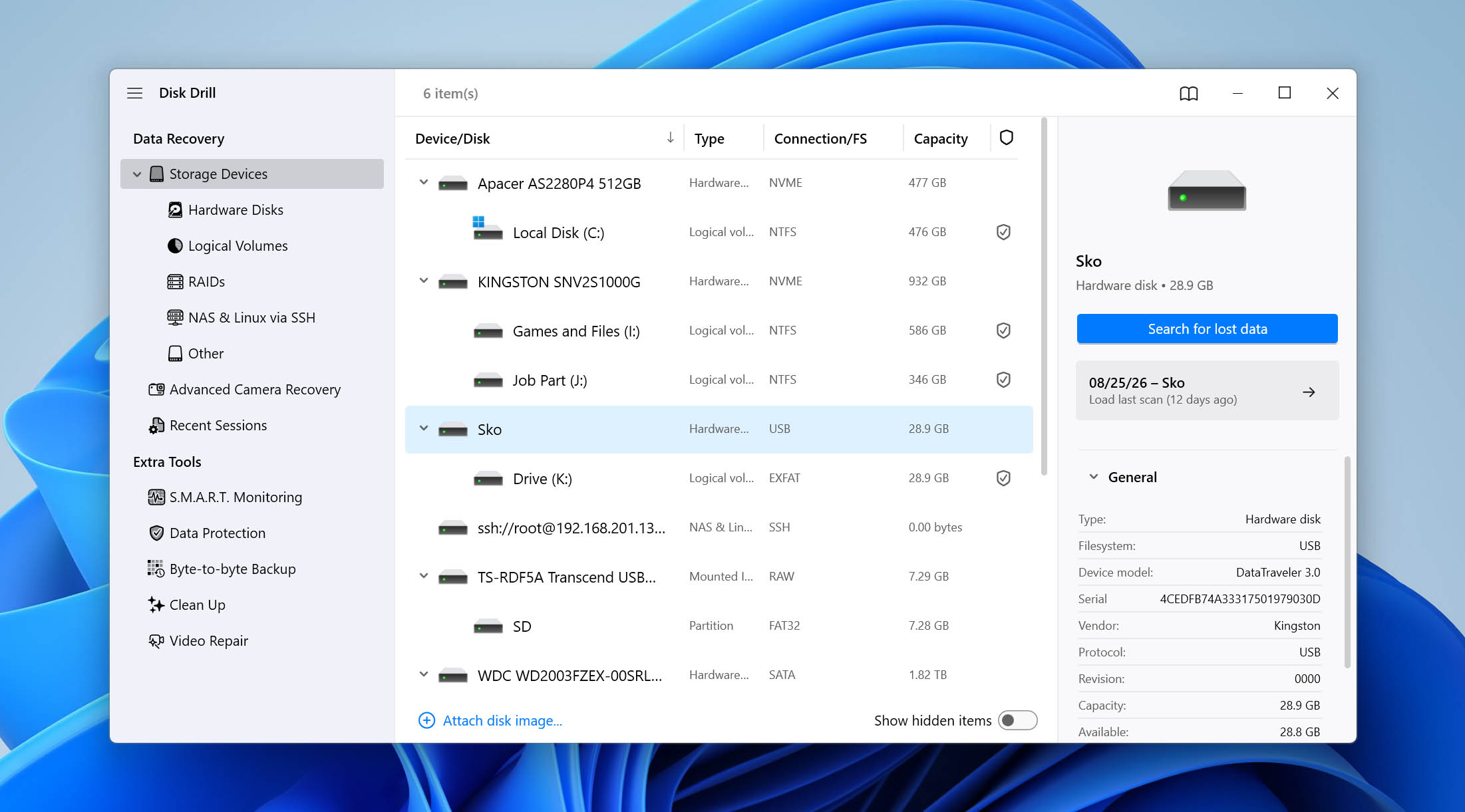
- Connect your USB and select it from the device list. Click Search for lost data to begin the scan.
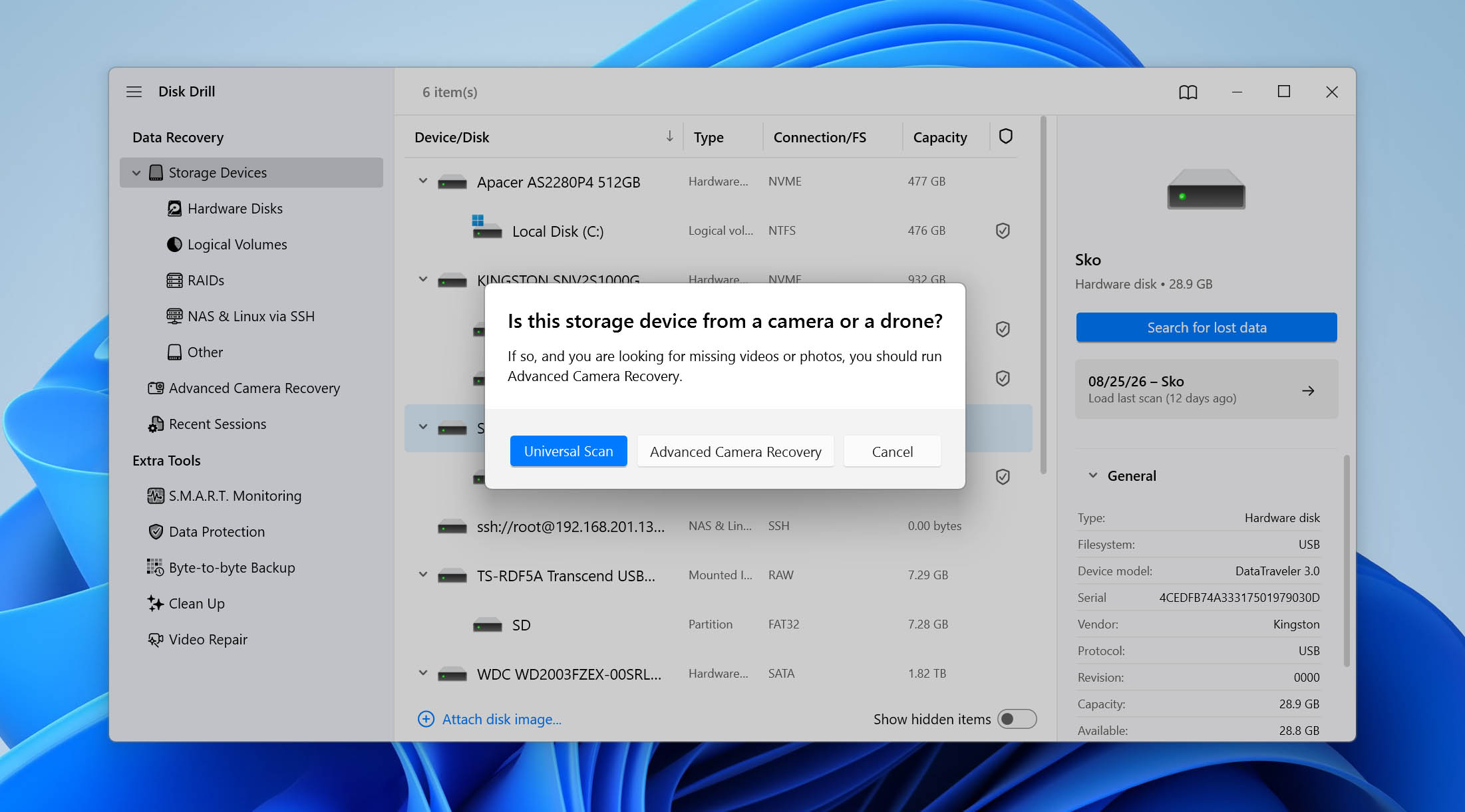
- Disk Drill will offer two scan options: Universal Scan and Advanced Camera Recovery. For disappeared files on a regular USB drive, Universal Scan is the right choice. Advanced Camera Recovery is intended for recovering fragmented video files from cameras and other recording devices. Select Universal Scan to continue.
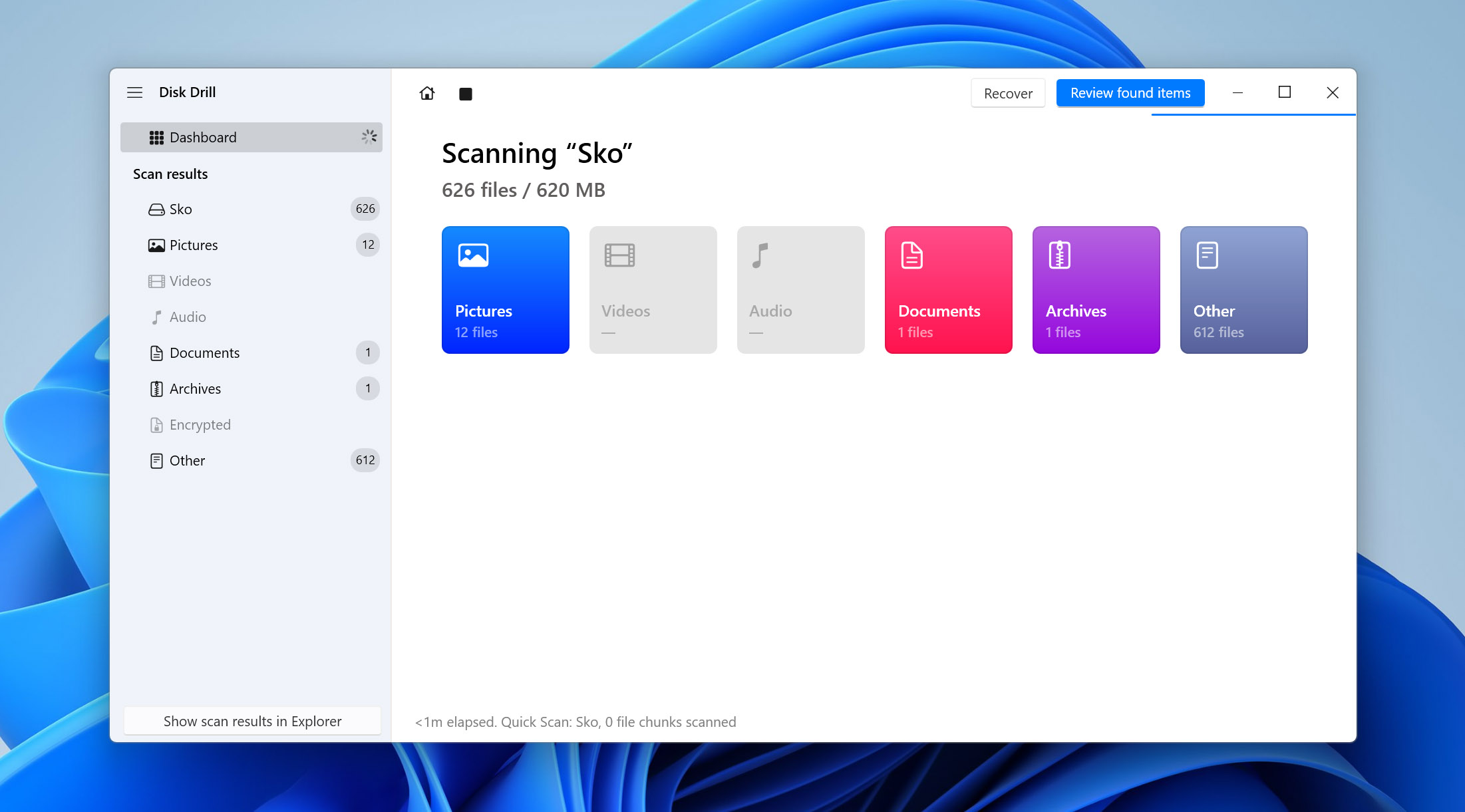
- Click Review found items to explore what Disk Drill discovered. Alternatively, click the colored file type icons to filter the results immediately, or just recover everything by clicking Recover all.
- If you also want to see hidden files in the scan results, click Show and check Show hidden system files.
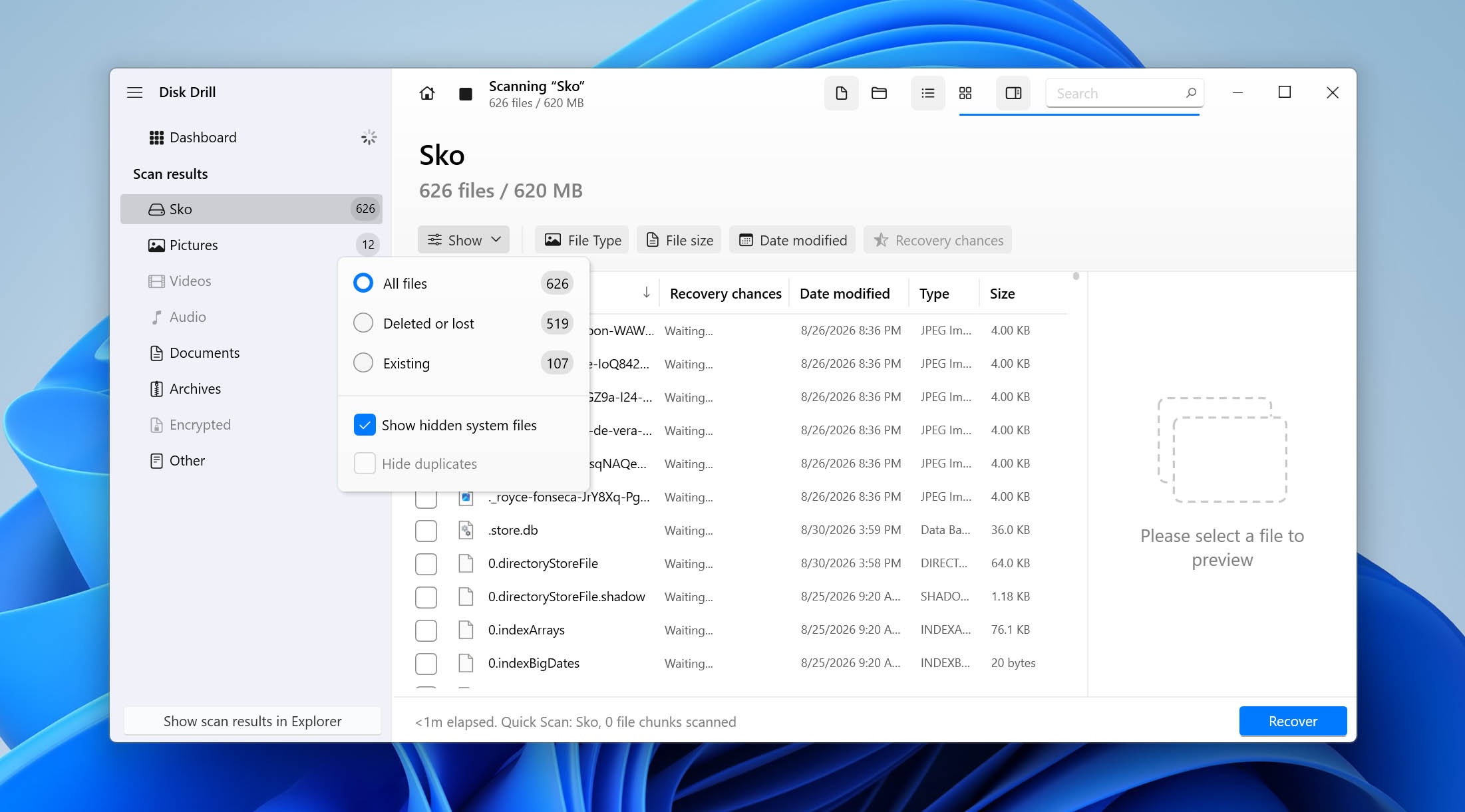
- Select the disappeared USB files that you want to recover. Check the Recovery Chances column for an estimate of how likely each file is to be recovered successfully, and preview important files whenever possible. When you’re ready, click Recover.
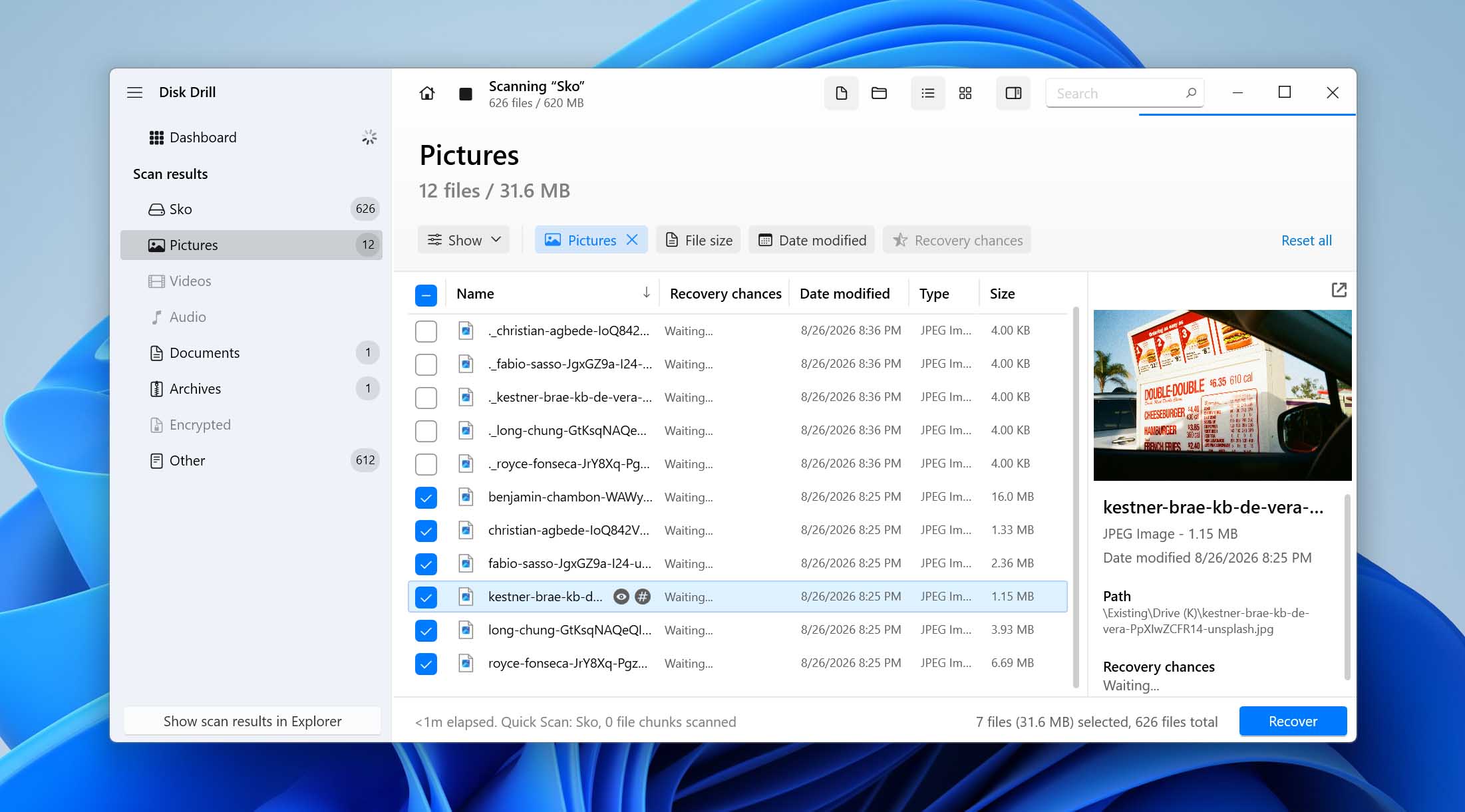
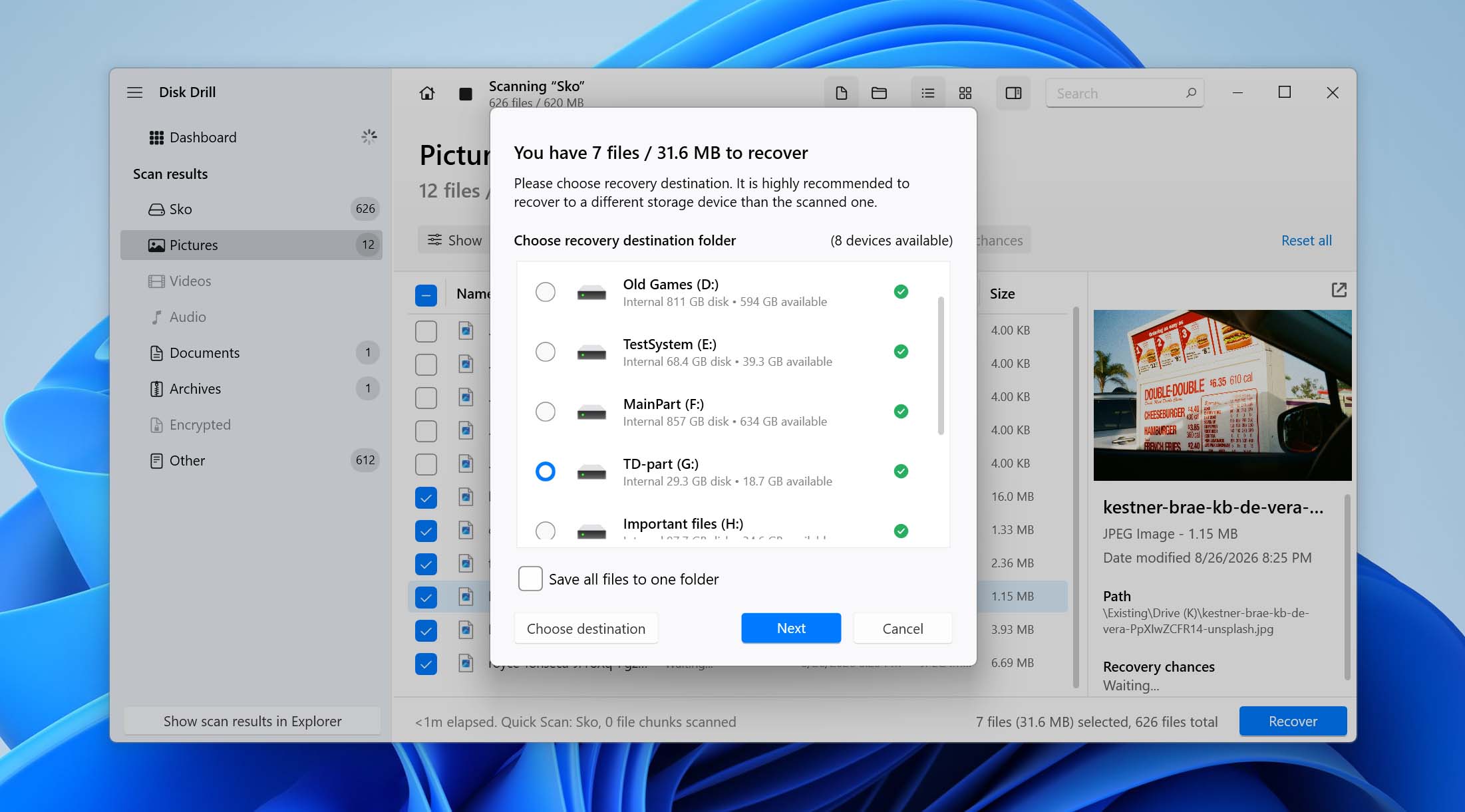
- Select a suitable recovery location. Make sure you don’t recover the files to the same USB you’re restoring them from. When ready, click Next to complete recovery.
Method 2: Reconnect the Flash Drive to Your PC
An unstable connection can cause issues with your computer reading your USB flash drive. Try ejecting your USB safely and then reconnecting it. Use a USB port that connects to your motherboard directly (on the backside of most computers), as the cable connecting your computer case’s USB ports to your motherboard may be faulty.
Method 3: Scan the USB Drive With Antivirus Software
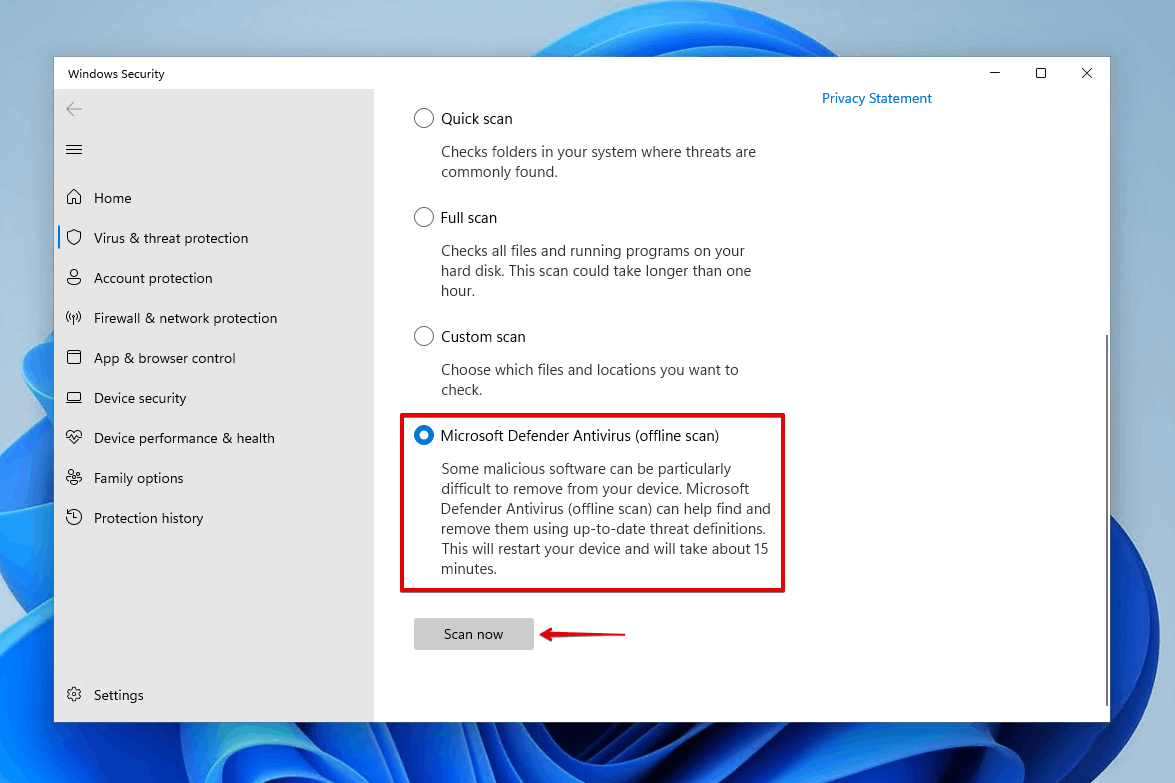
If your files are not showing up on your pen drive, it may be due to a virus that has hidden or deleted them. Before you attempt to unhide or recover them, make sure you remove the virus first. You can do this using Microsoft Defender Antivirus which comes with Windows 10 and 11 by default.
- Open File Explorer, right-click your USB drive, click Show more options, then select Scan with Microsoft Defender. Defender will scan the selected drive.
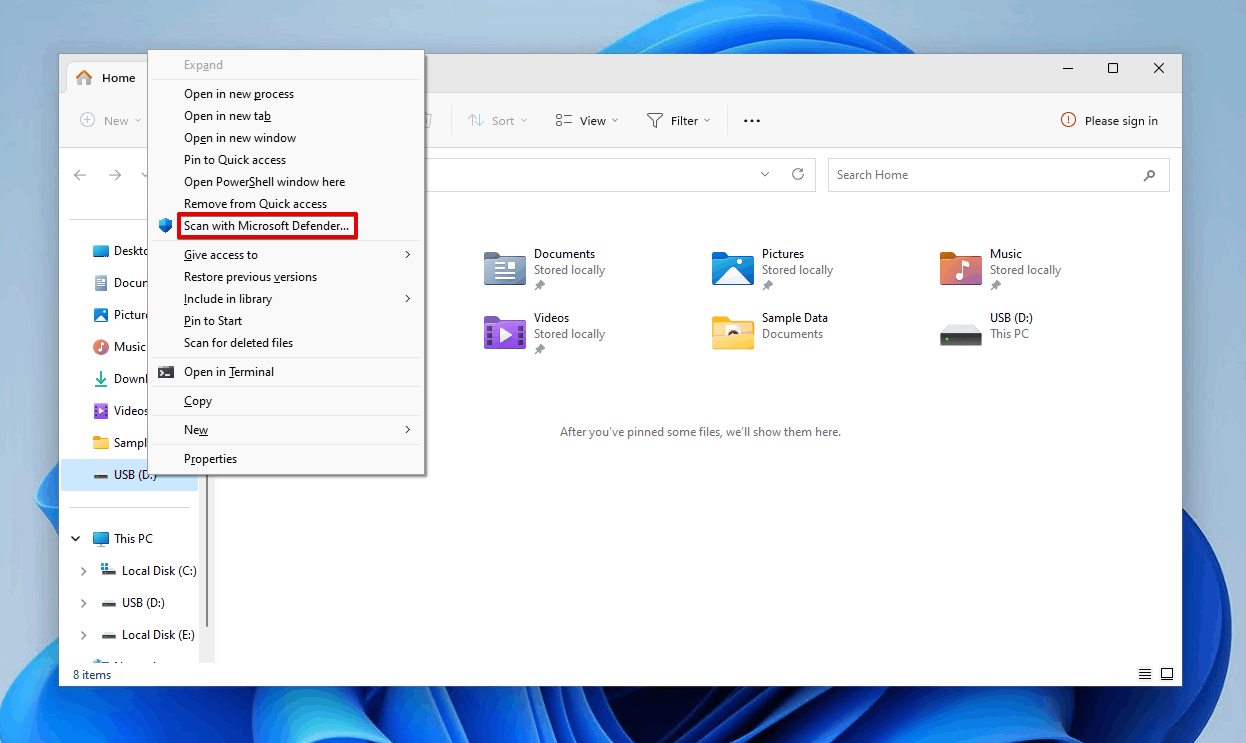
- For an additional scan of the USB drive, use a Custom scan and select the USB drive. Use Microsoft Defender Offline when you suspect persistent malware on the PC that may hide while Windows is running.
Method 4: Unhide Hidden Files & Folders
Are your USB files missing but the space is still used when you check File Explorer or Disk Management? There’s a chance they’re just hidden. The ‘hidden’ attribute can be applied to files so they won’t appear normally. You can show hidden files to unhide these files, then manually remove the ‘hidden’ attribute.
- Open File Explorer.
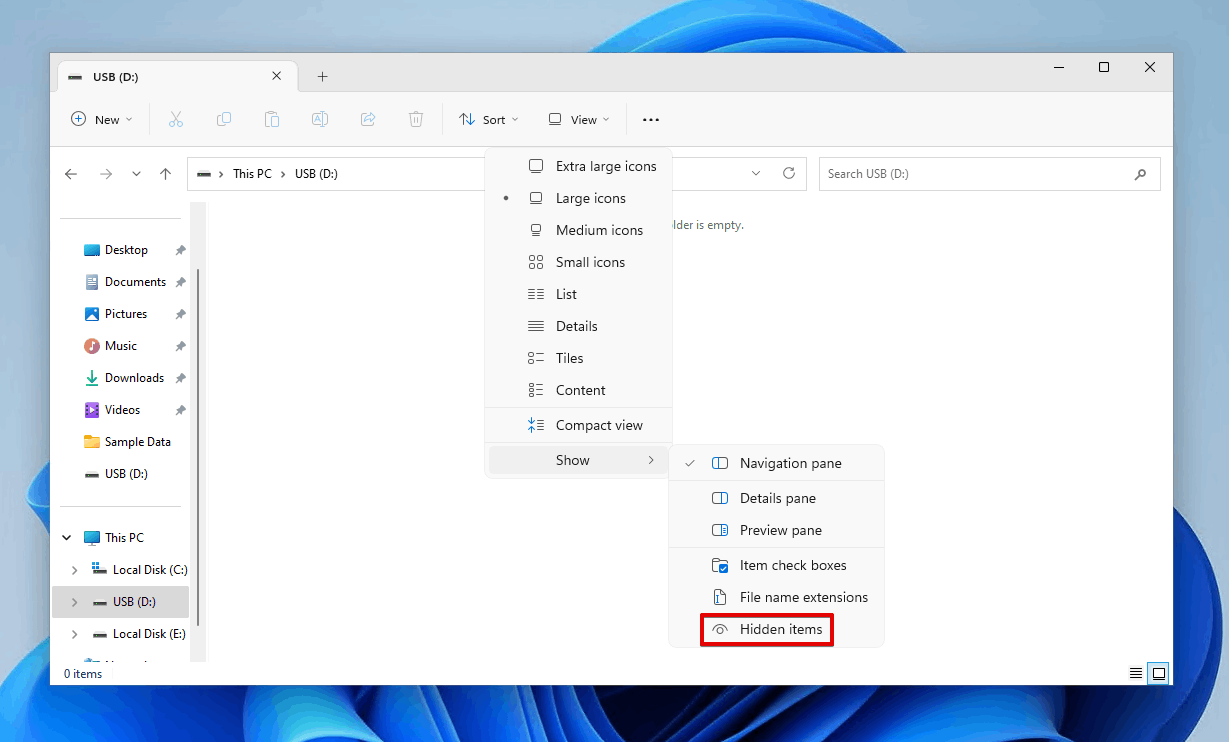
- Navigate to your USB drive. Click View, Show, then Hidden items.
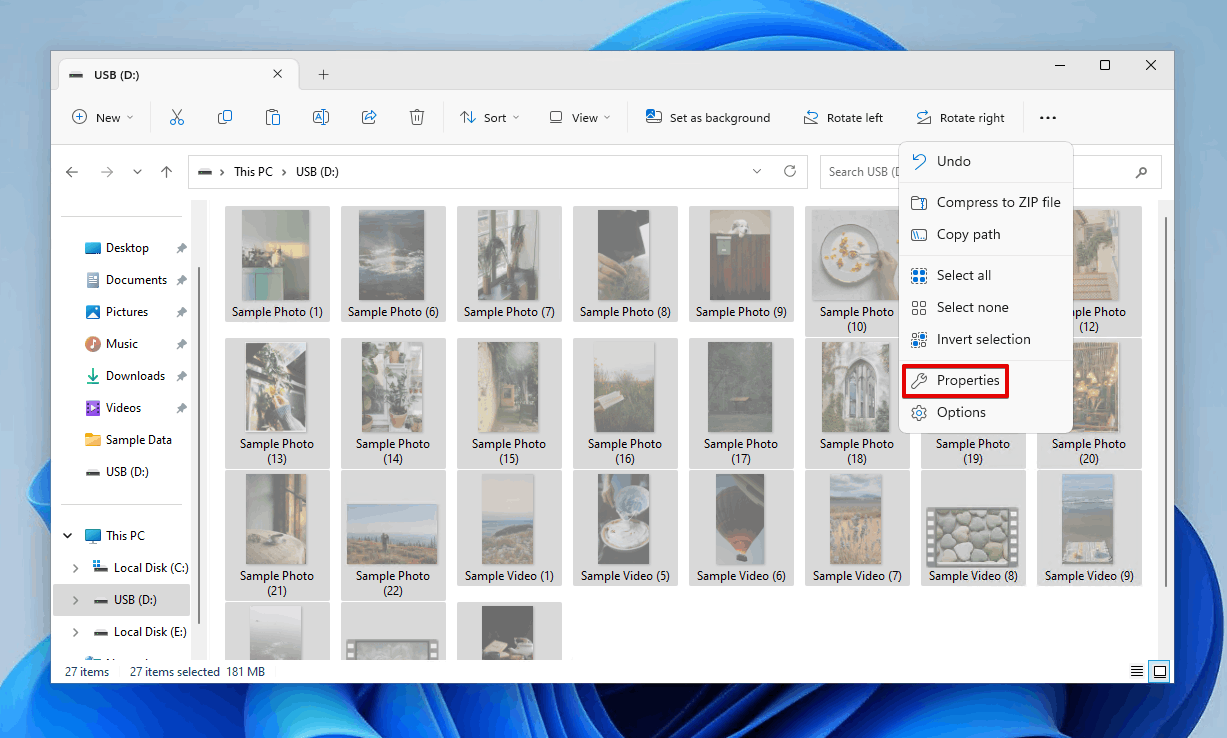
- Select all the hidden data and click Properties.
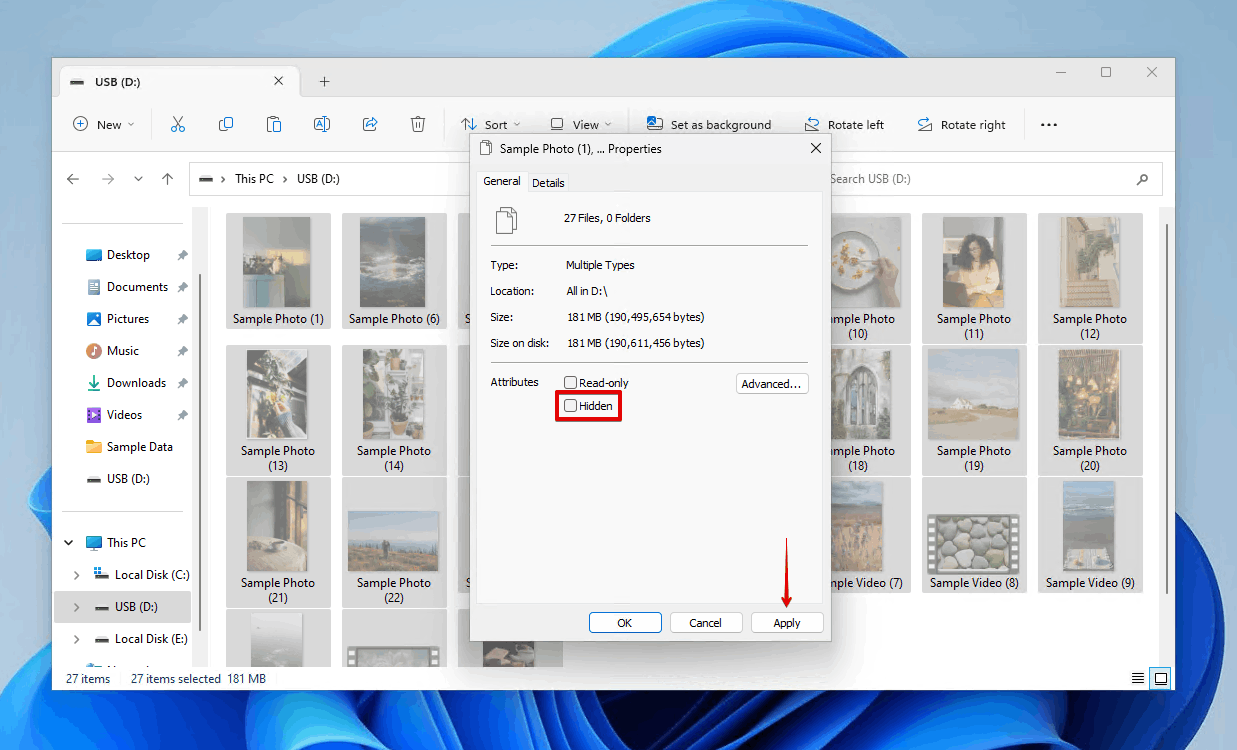
- Untick Hidden and click Apply.
Keep in mind that enabling Hidden items only makes hidden files visible. It doesn’t remove the attributes that caused them to be hidden in the first place. Malware, in particular, may apply the Hidden, System, or Read-only attributes, and File Explorer may not be enough to return everything to normal. In this case:
- Open Terminal or Command Prompt as administrator and run the attrib -h -r -s X:\*.* /s /d command, where X is the drive letter of your USB.
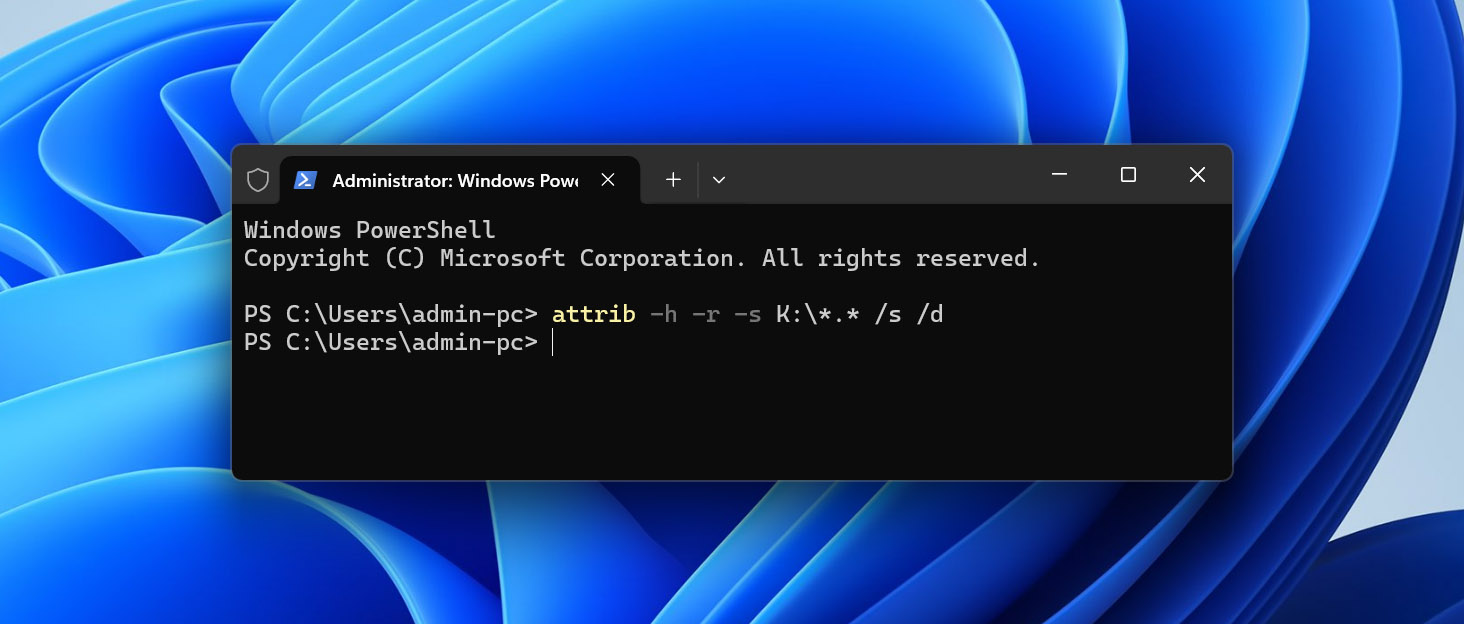
The command removes the Hidden (-h), Read-only (-r), and System (-s) attributes from files and folders on the drive, while /s applies the command to matching files in subfolders and /d includes directories. If files disappeared from your flash drive because their attributes were changed, they should become normally accessible again.
Method 5: Fix Flash Drive Errors Using Command Prompt
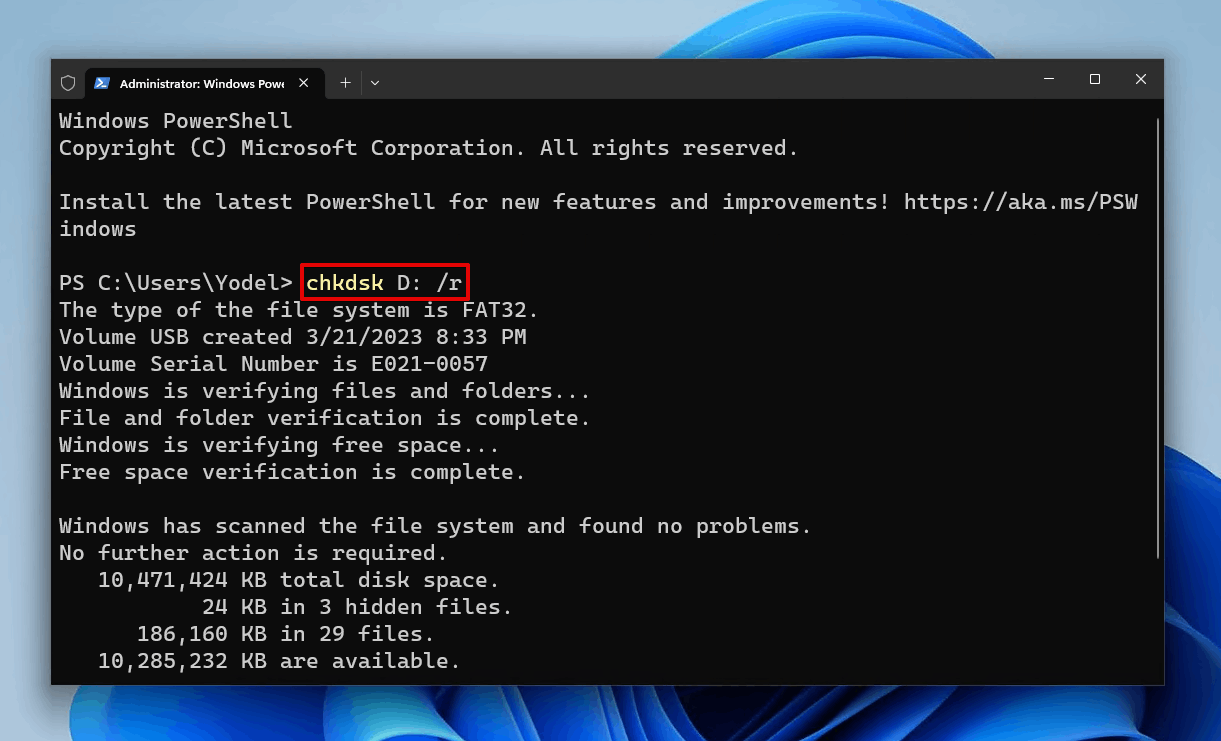
CheckDisk is a wondrous repair tool. It’s used to scan for and fix logical file system errors and problems with file system metadata. When files copied to a USB drive disappear due to some form of damage, try repairing the damage using CheckDisk. You can access it using CMD.
- Right-click Start and click Terminal (Admin).
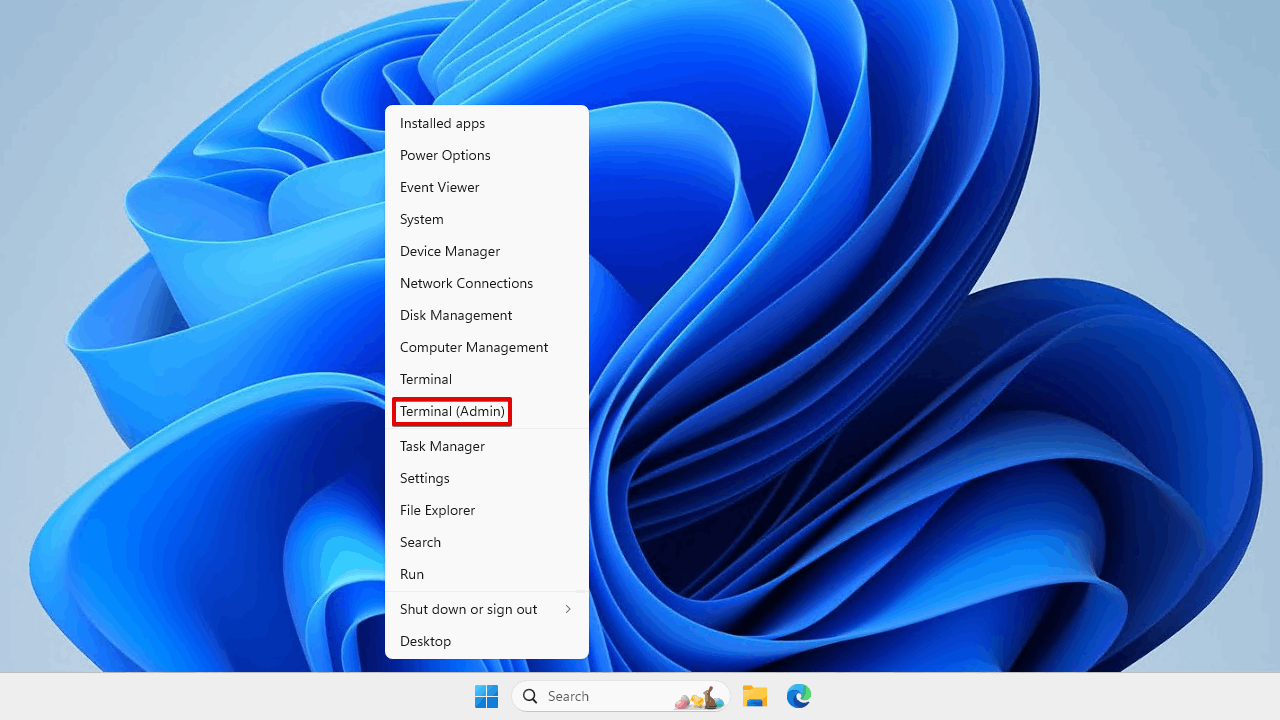
- Type chkdsk *: /r. Replace * with the drive letter of your USB drive. Press Enter.
Method 6: Perform a Quick Format of the USB Stick
You may be thinking a quick format is counterintuitive when you’re trying to get missing files back. And you’d be right to avoid it before recovery, since formatting makes the existing files inaccessible. But once your data is safely recovered, a quick format can be useful if the file system is damaged and can’t be repaired. It recreates the file system structures without performing a sector-by-sector erase of the USB. In cases like this, we recommend you follow the steps from Method 1 to recover your data first, then proceed with the steps below to quick format the USB flash drive.
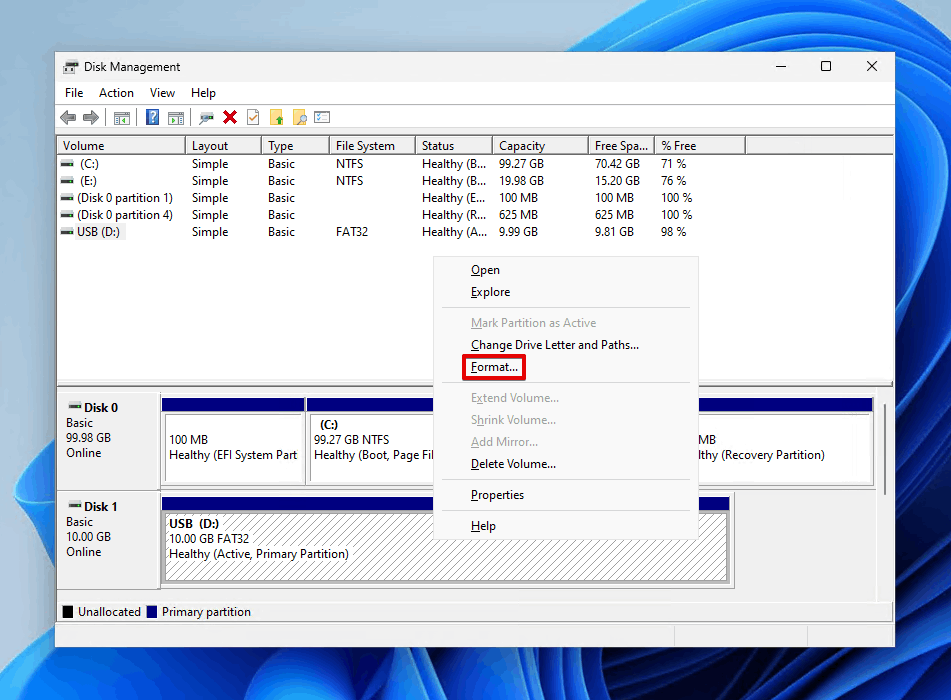
- Right-click Start and click Disk Management.
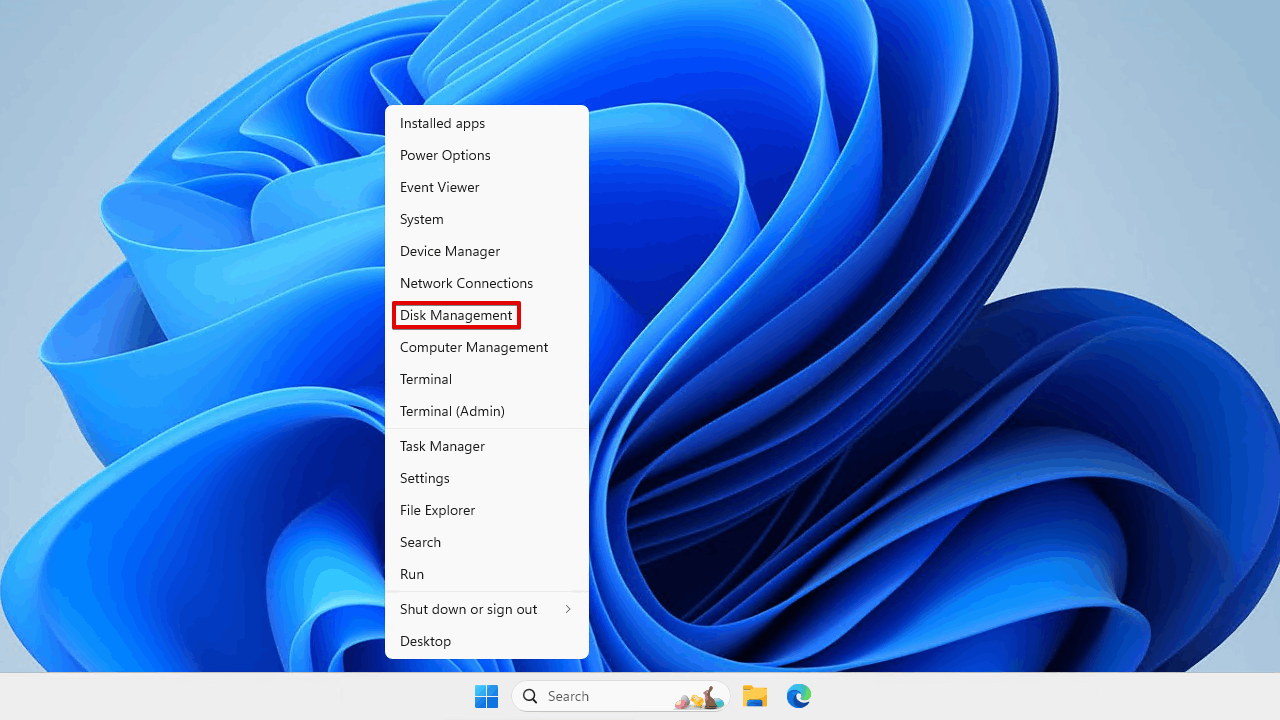
- Right-click the USB’s volume and click Format.
- Make sure Perform a quick format is enabled and click OK.
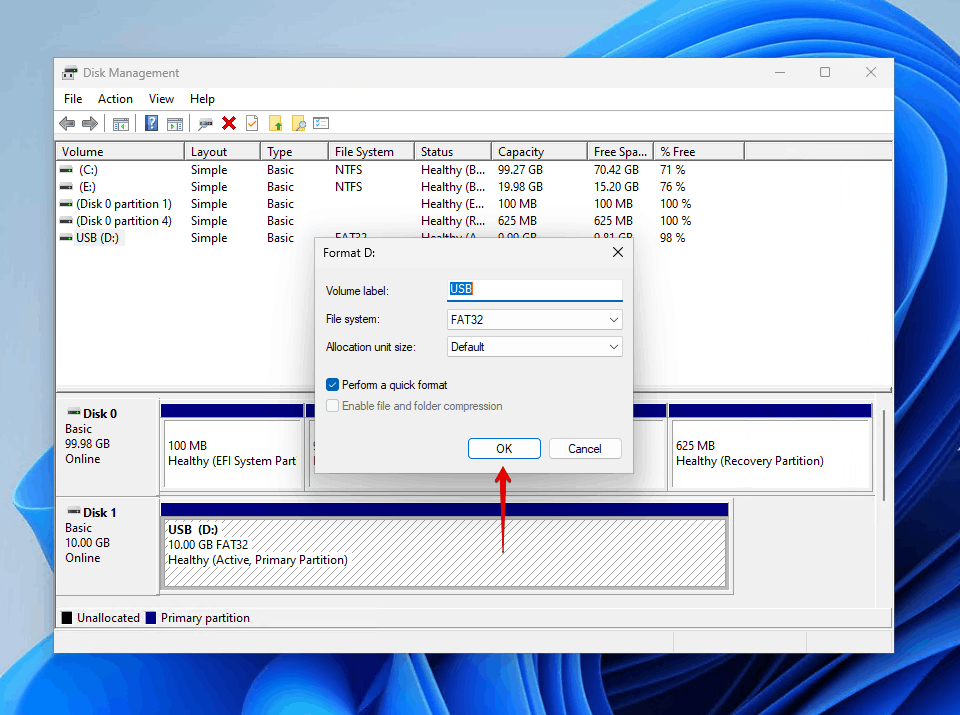
- Click OK to confirm the format.
Method 7: Restore a Lost USB Partition With DiskGenius
DiskGenius is both a disk management and data recovery tool. We’re not going to focus on its recovery abilities today. Instead, if the USB partition itself has disappeared, we’re going to use it to search for the lost partition and restore its entry to the partition table.
- Download and install DiskGenius.
- Right-click the USB drive and click Search Lost Partitions (Partition Recovery).
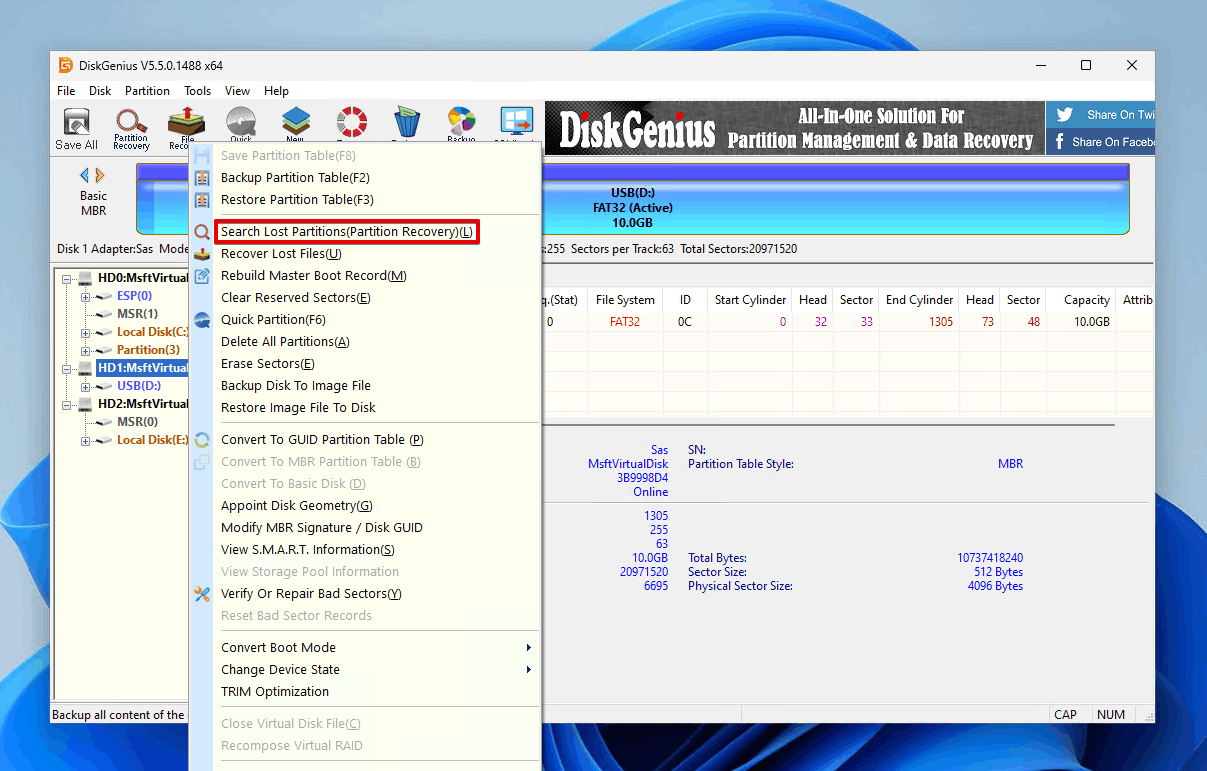
- Click Start.
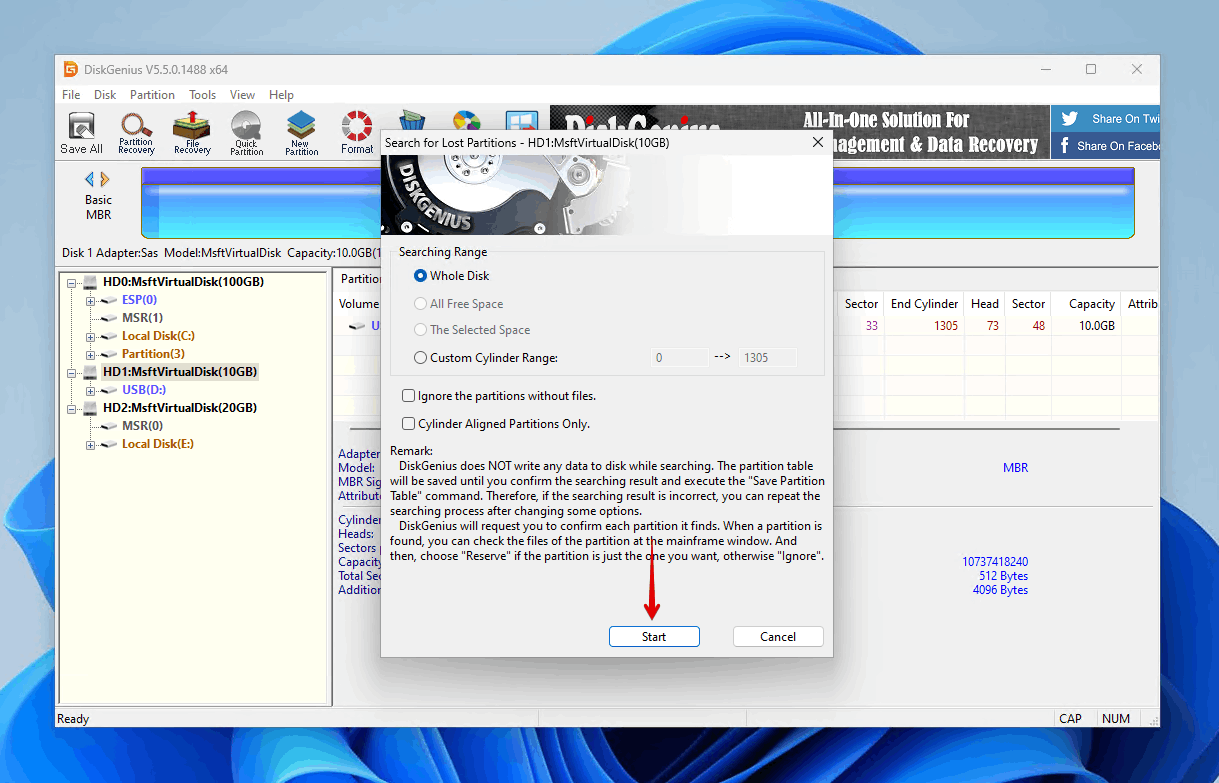
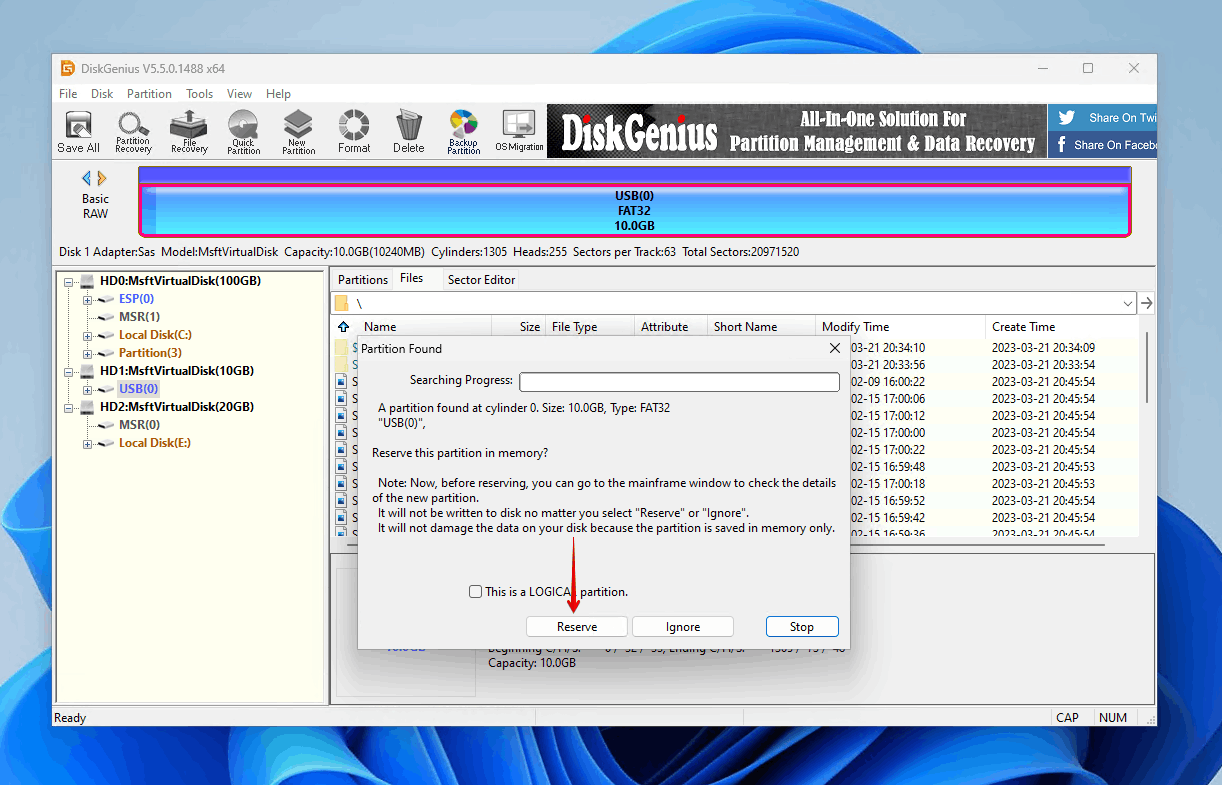
- Preview the files in the partition DiskGenius finds. If it’s the correct lost partition and the files you expect are visible, click Reserve. If not, click Ignore and continue the search.
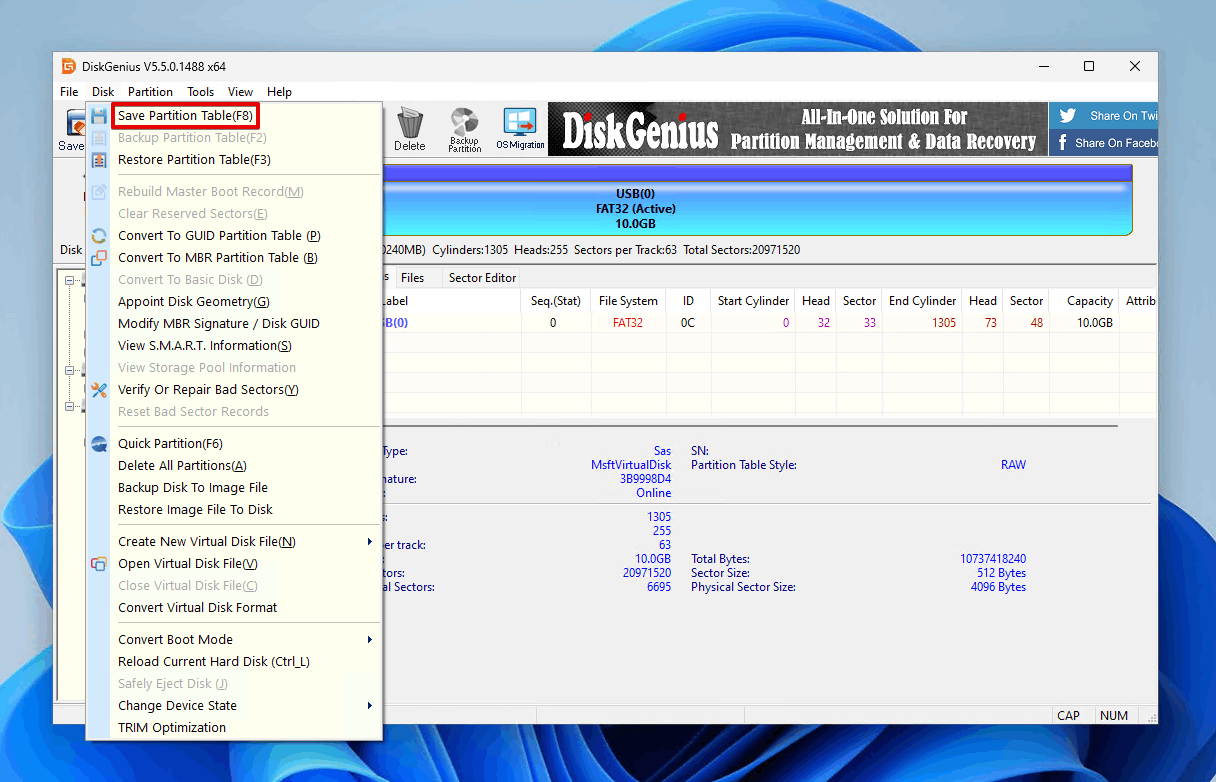
- Click Save, then Save Partition Table.
- Click Yes.
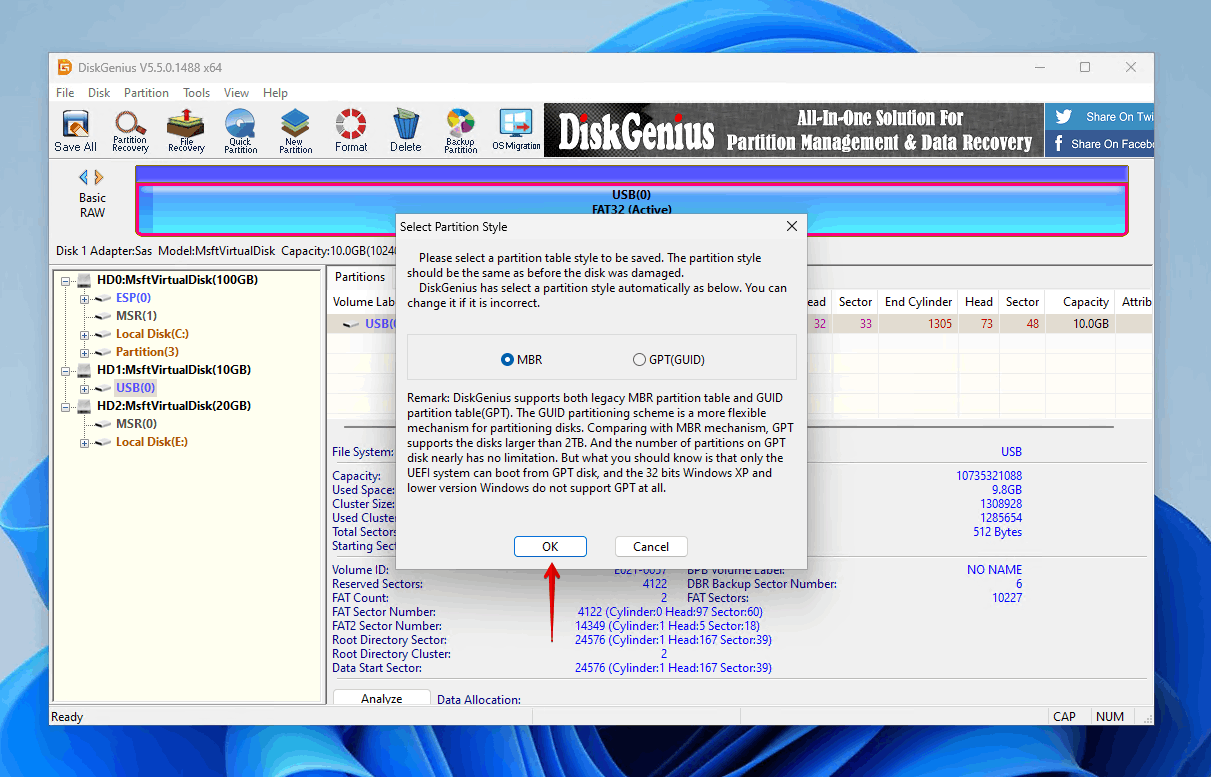
- Choose the partition style and click OK.
Frequently Asked Questions
How to recover deleted files from a flash drive without software?
Your best option to recover deleted files from a flash drive without software is by restoring the files from a backup. Alternatively, you can see if the files are simply hiding by showing hidden files.
How to recover data from a USB flash drive that is not recognized?
If the USB flash drive isn’t visible in File Explorer, check Disk Management first. If it appears there with the correct capacity, data recovery software may still be able to scan it and recover your files. If the USB isn’t detected at all, try another USB port or computer. If it still doesn’t appear or you suspect physical damage, consider a professional data recovery service.
How can I recover my files from a USB drive that disappeared?
You can recover files that have disappeared from your USB drive using the data recovery software Disk Drill:
- Download and install Disk Drill.
- Connect the USB and select it from the list of devices.
- Begin the scan for your files that disappeared.
- Select the missing files that you want to recover from the scan results.
- Recover the files to a safe location on another drive.
Is it possible to recover files that suddenly disappeared from a USB drive?
Your files may simply be hidden. Try showing hidden files first. Otherwise, if your files disappeared from your flash drive, you can recover them using data recovery software.
What is the best software for recovering files from a USB drive that disappeared?
After extensive review, we concluded that Disk Drill is the best software for recovering files that disappeared from a USB drive as it includes multiple scan modes and support for a wide range of file systems. You can also try Recuva, a completely free data recovery tool that’s great for data recovery on a budget.
Can I recover deleted files from USB without the software?
Flash drive files that disappeared or were deleted are best recovered using a backup. You can also try showing hidden files on the USB to see if the files have been marked with the ‘hidden’ attribute by mistake. The best method for recovering permanently deleted files is data recovery software.
How can you prevent files from disappearing from a USB drive again?
To reduce the chances of files disappearing from your USB drive again, always eject the drive safely before disconnecting it and avoid removing it while files are being copied. Keep backups of important files instead of storing the only copy on a thumb drive, and scan the USB for malware if you regularly connect it to different computers. If the drive starts disconnecting unexpectedly, reporting the wrong capacity, or asking to be formatted, stop using it until you’ve backed up or recovered the data.
How can you tell why your USB files disappeared?
Start by checking how the USB behaves in Windows. See whether you can open it in File Explorer, then check Disk Management to make sure the drive is detected and shows the correct capacity. What you find can help narrow down the problem. For example, missing files on an otherwise working USB may be hidden or deleted, while a format prompt can point to file system corruption. Use the table below to compare the symptoms with the most likely cause.
What should you do immediately when files disappear from a USB drive?
Stop using the USB as soon as you notice that files are missing. Don’t copy new data to it, format it, or run repair tools yet, as any of these actions can overwrite deleted files or make recovery more difficult. First, check whether the files are simply hidden. If they were deleted or became inaccessible, recover them to another drive before trying to fix the USB itself.
What does it mean if a USB shows used space but no files?
If your USB shows used space but no files appear in File Explorer, the data may still be there. The files could simply be hidden, either because their attributes were changed manually or by malware. Enable Hidden items in File Explorer first. If that doesn’t bring them back, you can use the ATTRIB command to remove Hidden and System attributes or scan the drive with data recovery software if the files are no longer accessible.
Can files still be recovered if a USB shows 0 bytes?
Possibly, but a USB showing 0 bytes is a more serious sign than a few missing files. First, check the drive in Disk Management. If Windows reports 0 bytes there as well, or doesn’t show the USB’s correct capacity, data recovery software may not be able to scan it properly. Avoid formatting or repairing the drive and consider a professional data recovery service instead.
What should you do if a USB asks you to format it?
Don’t format the USB if it contains files you still need. A format prompt can appear when Windows can’t read the drive’s file system, often because it has become corrupted or uses a file system Windows doesn’t support. If Disk Management still detects the USB with the correct capacity, recover your files to another drive first. Once the data is safe, you can format the USB and see whether that returns it to normal use.
How can you recover missing files if a USB became RAW?
If your USB became RAW, Windows can no longer recognize its file system, so the files may disappear even though the data is still on the drive. Don’t format it, even if Windows prompts you to. If Disk Management detects the USB with the correct capacity, recover the files to another drive first. For a more detailed walkthrough, see our guide on recovering files from a RAW drive. After recovery, you can format the USB with a supported file system and use it again.
What should you do if files keep disappearing from the same USB drive?
If files keep disappearing from the same USB drive, don’t continue using it for important data. Repeated data loss can point to file system corruption, malware, a failing drive, or even a fake USB that reports more capacity than it actually has. Recover any files you still need, check the drive for errors and malware, and verify that its reported capacity is genuine. If the problem returns after formatting, replace the USB.
How long do deleted files remain recoverable on a USB drive?
There’s no fixed amount of time. Deleted files can remain recoverable until new data overwrites the space they occupied, whether that happens minutes later or months later. If you need to recover deleted files, stop using the USB immediately. Even copying a single new file to the drive can overwrite some of the deleted data and reduce your chances of getting it back.
Final Thoughts
You may plug your USB drive into your computer one day and notice that some of your files have disappeared. The files may be hidden, deleted, or inaccessible because of file system or partition damage. If they’re simply hidden, you can show hidden files and remove the attributes keeping them out of view. If they were deleted or became inaccessible, recover them using a data recovery tool before attempting any repairs.
Once your files are recovered, you can address logical file system problems with CheckDisk or, when appropriate, by reformatting the drive. Physical hardware damage is a different matter and may require a professional data recovery service instead. Be sure to back up your data so you have a copy to restore from in case you face another data loss event in the future.

- 48 publishings
- Auckland, New Zealand
Jordan Jamieson-Mane is a content writer with a focus on technology-related content. He has spent much of his life studying and working with all types of technology. During his time as a writer, he has written countless articles in the field of data recovery, breaking down complex topics into articles that are easy to understand.
When he's not writing articles on data recovery, Jordan enjoys traveling the world, reading books, and building websites.
- LC Tech FILERECOVERY Professional Review – Can It Compete with Modern Recovery Tools?
- UFS Explorer Review – A Powerful Recovery Tool With Lots to Offer
- Cisdem Data Recovery for Windows Review – A Capable Copy
- AnyRecover Data Recovery Review – A Polished Solution for Basic Users
- iBoysoft Data Recovery Review: Not Much to Offer
- Frisco, Texas, United States
Yevgeniy Tolkunov is Hardware Engineer at ACE Data Recovery. Yevgeniy has a Master's Degree in Physics, Information Technology; 15+ years of experience.